Heavy, Regular and Casual Usage Compared
Three usage profiles describe most adult AI chat habits, and they differ by a factor of thirty in monthly hours. A casual pattern of four sessions a month at 15 minutes is 1 hour; a regular pattern of 16 sessions at 30 minutes is 8 hours; a heavy pattern of 40 sessions at 45 minutes is 30 hours. The behaviours inside each profile are more different than the totals suggest.

Key takeaways
- Casual: 4 sessions a month at 15 minutes is 1 hour, roughly 10 messages a day or 300 a month.
- Regular: 16 sessions at 30 minutes is 8 hours, roughly 40 messages a day or 1,200 a month.
- Heavy: 40 sessions at 45 minutes is 30 hours, roughly 120 messages a day or 3,600 a month.
- All three profiles face the same ratio test on a card — 4.7K favourites from 18.2M views is about 0.026%, and that number means the same thing whoever is reading it.
The casual profile: short visits, wide sampling
Casual use is characterised by short visits and low commitment per visit. Fifteen minutes is enough for an exchange or two and not enough to develop a long thread, so casual readers typically sample more cards and save fewer. Ten messages a day across 30 days is 300 messages a month, and in a 60-minute month that works out at 12 messages for every minute of platform time — a fast, shallow pattern rather than a slow one.
The advantage is low friction: there is very little to maintain, and a missed week costs nothing because nothing was built on the previous one. That is the ordinary trade of a Porn Chat AI habit: reach against depth, and the two move in opposite directions. Characters recall previous interactions, but a pattern of four visits a month gives that memory little to work with, so the experience stays closer to a series of encounters than to a developing conversation.
The regular profile: the middle that most advice is written for
Four sessions a week, half an hour each, is the shape most guidance assumes, and for good reason. It is 8 hours a month, which is enough to develop a thread, switch characters when one stalls and still leave room for other things. Forty messages a day is 1,200 a month, and a two-minute setup per session costs 32 of the month's 480 minutes — about 6.7%, which is a reasonable tax.
The regular profile is also where saving behaviour becomes meaningful. Two to six new characters in the first month, rising to eight or twelve by the third, is a pile of material you can actually revisit rather than a list you skim. Regularity, not intensity, is what makes recall useful.
The heavy profile: high volume, and where it breaks
Forty sessions a month at 45 minutes is 30 hours, or roughly an hour a day. At 120 messages a day that is 3,600 a month, and the arithmetic is what makes the profile distinctive: the sheer volume of input means retained context is being refreshed constantly, so continuity is strong, but selection overhead also grows because there is more material to keep track of.
The failure mode is not the hours themselves; it is drift. When sessions are long and frequent, the setup step gets skipped because the conversation is already warm from yesterday, and a thread with no fresh framing tends to repeat itself. That is why heavy usage benefits more, not less, from the two minutes of framing that a casual reader can reasonably skip.
| Profile | Sessions and length | Monthly figure | Good at |
|---|---|---|---|
| Casual | 4 sessions at 15 minutes | 1 hour, about 300 messages | Sampling broadly with no maintenance |
| Regular | 16 sessions at 30 minutes | 8 hours, about 1,200 messages | Developing threads and keeping a library |
| Heavy | 40 sessions at 45 minutes | 30 hours, about 3,600 messages | Deep continuity across many characters |
| Setup cost | 2 minutes per session | 8 minutes a month casual, 80 heavy | Framing that stops long sessions drifting |
| Keep rate benchmark | Any profile | 4.7K ÷ 18.2M is about 0.026% | Comparing cards on the same measure |
Worked example: the same three cards, three profiles
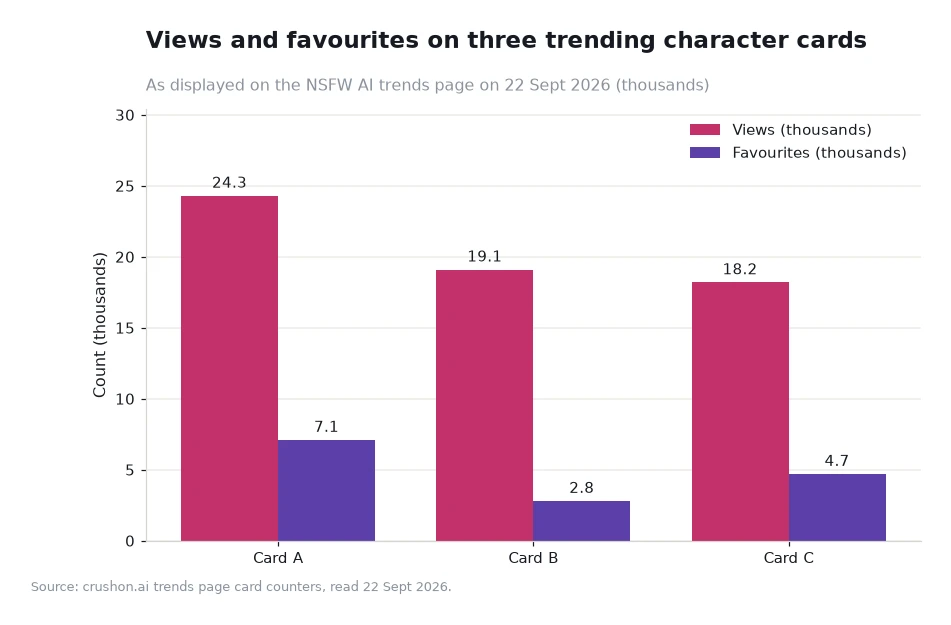
Take the counters published on 22 Sept 2026: the leading card at 24.3M views and 7.1K favourites, the second at 19.1M and 2.8K, the third at 18.2M and 4.7K. Divide favourites by views and the keep rates are about 0.029%, 0.015% and 0.026% respectively. Those ratios do not change with the reader, which is the point: the measure describes the catalogue, and every profile reads it the same way.
What changes is how many cards a profile can test against them. Casual at 1 hour a month, using a 12-minute per-card trial, can evaluate five cards a month, so a three-card shortlist takes most of the month. Regular at 8 hours can evaluate forty, which is two full weekly chart passes. Heavy at 30 hours can evaluate a hundred and fifty, which is more than any single week's catalogue worth of ranked entries. The heavier the usage, the more the shortlist matters, because a hundred and fifty trials a month produces more candidates than anyone can supervise.
Choosing a profile instead of drifting into one
Pick the profile deliberately by deciding hours first: 1, 8 or 30 for the three patterns above, then work out which combination of sessions and length gets you there. A reader who wants regular usage but only has 30 minutes a week should run four 7-minute sessions rather than one 30-minute session, because the frequency is what makes recall useful.
Whatever the profile, the porn ai chat page describes the same product for all three, so the differences are entirely about how you allocate time rather than about access. Readers who want to sample across the profile boundaries can use the NSFW AI trends list for breadth and the character search for depth, and compare what each produces after a month.
Frequently asked questions
Which profile is the most common?
The regular one, at roughly 16 sessions a month, because it fits a normal week and produces enough continuity for recall to matter. Casual use is more common among new readers, who often move toward regular use within a couple of months.
Is heavy usage different in kind from regular usage?
It is different in scale and in failure mode. Continuity improves with volume, while drift gets worse because the framing step is easy to skip when a conversation is already warm, and that is what makes 30-hour months harder to keep tidy.
Does the profile change what a card's counters mean?
No. A keep rate of about 0.026% describes the card, not the reader, so the same ratio is comparable across profiles. What differs is how many cards each profile has the time to test.
Pick the numbers, then let the habit follow
Choose between 1, 8 and 30 hours a month before choosing anything else, then express the choice as sessions and length. Write the total down and check it again after four weeks, because the profile that fits is the one you can sustain without renegotiating it every week. The platform does not change between profiles; only the size of the commitment does.
Data and sources: counters on the Crushon trends page[1] and the platform's description of how characters recall earlier interactions[2], read 22 Sept 2026. Session counts, monthly hours and message volumes are illustrative assumptions; the keep rates are arithmetic on the published counters. Adults 18 and over are the intended audience of this article.